

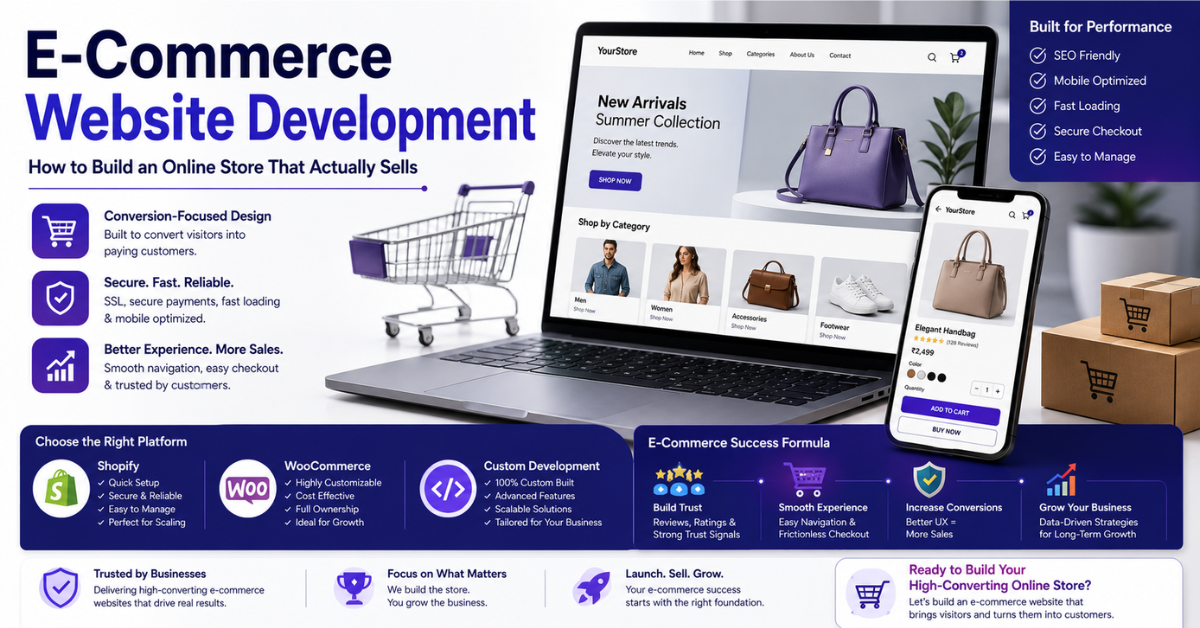
E-Commerce Website Development : How to Build an Online Store That Actually Sells
Your E-Commerce Website Is Costing You Money Right Now
Most e-commerce business owners focus on getting traffic.
The real problem is usually conversion.
You can spend money on SEO, Google Ads, Meta Ads, influencer marketing, and social media marketing, but if your e-commerce website isn’t converting visitors into customers, you’re losing revenue every day.
I recently reviewed an online store that had invested heavily in website development and digital marketing.
The website looked professional.
The products were good.
Traffic was coming in.
Sales weren’t.
The issue wasn’t traffic generation. The issue was website conversion optimization.
After improving product pages, simplifying the checkout process, adding customer reviews, and improving trust signals, the store started converting significantly more visitors into paying customers.
The lesson?
Getting visitors is only half the battle.
Converting them is where revenue is made.
Benefits of E-Commerce Website Development

What Makes People Actually Buy? Understanding E-Commerce Psychology
Before choosing a platform or investing in e-commerce website development, it’s important to understand why customers buy.
Product Pages That Answer Questions
Customers want answers before making a purchase.
Common questions include:
- Is this the right size?
- What material is it made from?
- How long does shipping take?
- What is the return policy?
If customers cannot find answers quickly, many leave without buying.
Social Proof
Reviews and ratings reduce purchase anxiety.
When visitors see that other customers have purchased and enjoyed a product, trust increases.
Transparent Shipping and Returns
Unexpected charges are one of the biggest causes of abandoned carts.
Shipping costs and return policies should be clearly visible before checkout.
Fast Checkout Experience
Every additional step creates friction.
The easier the checkout process, the higher the conversion rate.
Trust Signals
Customers are more likely to buy when they see:
- Secure payment gateways
- SSL certificates
- Contact information
- Return policies
- Recognized payment methods
Trust directly impacts conversions.
Shopify vs WooCommerce vs Custom Development
Choosing the right e-commerce platform is one of the most important decisions you’ll make.
Shopify
Shopify is one of the most popular e-commerce website platforms available today.
Benefits include:
- Fast setup
- Built-in security
- Reliable hosting
- Easy product management
- Minimal technical maintenance
Shopify works well for businesses that want to launch quickly.
WooCommerce
WooCommerce is built on WordPress and offers greater flexibility.
Advantages include:
- Lower long-term platform costs
- Greater customization
- Ownership of website data
- Large plugin ecosystem
WooCommerce is ideal for businesses that want more control over their website.
Custom E-Commerce Development
Custom-built solutions provide complete flexibility.
However, they also require larger budgets, ongoing maintenance, and longer development timelines.
For most businesses, Shopify or WooCommerce provides everything needed for growth.
How We Build E-Commerce Websites
Successful e-commerce websites are built around user experience and conversion optimization.
Week 1–2: Planning and Setup
This includes:
- Domain setup
- Hosting configuration
- Payment gateway integration
- Shipping configuration
- Platform setup
Week 2–3: Website Design
The focus is creating:
- Conversion-focused homepage
- Category pages
- Product page layouts
- Mobile-friendly design
Week 3–4: Product Optimization
Product pages include:
- Professional product images
- SEO-friendly descriptions
- Pricing information
- Product variations
Week 4–5: Analytics and Tracking
Tracking tools help measure:
- Website traffic
- User behavior
- Conversion rates
- Sales performance
Week 5–6: Testing and Launch
Before launch, every process should be tested:
- Checkout flow
- Payment processing
- Order confirmation
- Mobile responsiveness
- Email notifications
Why E-Commerce Website Development Matters for Online Sales,What Impacts E-Commerce Conversion Rates?
Many online stores lose sales because of avoidable mistakes.
Poor Product Photography
High-quality images help customers visualize products and build confidence.
Weak Product Descriptions
Descriptions should explain benefits, materials, usage, sizing, and key features.
Lack of Customer Reviews
Reviews increase trust and help visitors make purchasing decisions.
Complex Checkout Process
Simpler checkout processes typically result in higher conversion rates.
Poor Mobile Experience
A large percentage of online shoppers browse and purchase from mobile devices.
Mobile optimization is essential.
Hidden Costs
Unexpected shipping fees and charges increase cart abandonment rates.
Transparency improves trust and conversions.
E-Commerce Website Development Platforms: Shopify vs WooCommerce
What Does E-Commerce Website Development Cost?
The cost depends on features, platform selection, and business requirements.
Website Development
Typical investment:
₹1,00,000 – ₹3,00,000
Depending on:
- Design requirements
- Product volume
- Platform selection
- Custom functionality
Ongoing Costs
Businesses should also budget for:
- Website maintenance
- SEO services
- Google Ads
- Meta Ads
- Email marketing
- Content marketing
A website alone does not generate sales.
Consistent marketing drives long-term growth.
Frequently Asked Questions
How much revenue can an e-commerce website generate?
Revenue depends on traffic, conversion rates, product pricing, and marketing effectiveness.
Should I choose Shopify or WooCommerce?
Shopify is ideal for speed and simplicity. WooCommerce is ideal for flexibility and ownership.
How long does e-commerce website development take?
Most projects take between 4 and 8 weeks depending on complexity.
Is website development enough to grow sales?
No.
Website development creates the foundation.
SEO, Google Ads, Meta Ads, email marketing, and conversion optimization drive growth.
Ready to Build an E-Commerce Website That Converts?
Many online stores focus entirely on design while ignoring customer psychology, conversion optimization, and user experience.
The most successful e-commerce websites are not necessarily the most visually impressive.
They are the easiest to trust, navigate, and buy from.
The Real Summary
- Traffic alone does not generate revenue.
- Conversion optimization is critical for e-commerce success.
- Shopify is often the fastest path to launch.
- WooCommerce offers greater flexibility and control.
- Product pages, reviews, and checkout experience directly impact sales.
- Mobile optimization is essential.
- Marketing and website development must work together.
- Long-term growth comes from continuous testing and improvement.
The difference between a struggling online store and a successful one is rarely the platform.
More often, it’s the customer experience.
Businesses that remove friction, build trust, and focus on conversions consistently outperform those that focus only on design.
Businesses can learn more about e-commerce best practices from Shopify’s official resources.
