

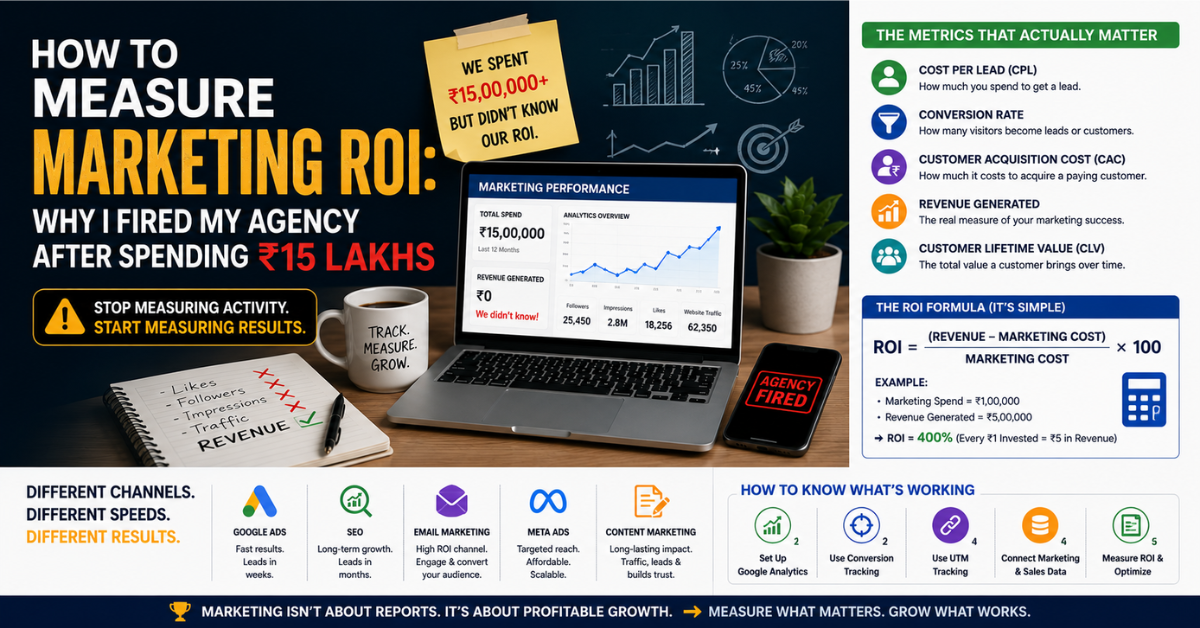
How to Measure Marketing ROI: Why I Fired My Agency After Spending ₹15 Lakhs
The Day I Realized We Were Throwing Money Away
How to Measure Marketing ROI is one of the most important skills for business owners investing in SEO, Google Ads, Meta Ads, and digital marketing campaigns.
Real talk: I once reviewed a company’s marketing performance after they had spent nearly ₹15 lakhs over 12 months.
The agency reports looked impressive.
There were colorful charts, rising graphs, follower growth reports, website traffic reports, and social media engagement statistics.
Everything appeared to be moving in the right direction.
Then I asked a simple question:
“How much revenue did this marketing generate?”
How to Measure Marketing ROI Effectively
Silence.
The CEO didn’t know.
The CFO didn’t know.
The marketing manager didn’t know.
Despite investing lakhs into digital marketing, nobody could clearly explain whether the campaigns had actually generated profit.
That’s when I realized a major problem in the industry.
Many businesses are measuring activity instead of results.
They’re tracking likes, impressions, and followers while ignoring the one thing that matters most:
How to Measure Marketing ROI Effectively
If you’re investing in SEO, Google Ads, Meta Ads, social media marketing, or content marketing, understanding your digital marketing ROI isn’t optional—it’s essential.
Let’s Talk About What Nobody Cares About
Many agencies proudly showcase numbers that look impressive in reports but often fail to answer the most important business question:
“Did this marketing make money?”
Followers
A business can have 100,000 followers and still struggle to generate sales.
Followers alone do not indicate marketing success.
Impressions
Getting your content in front of thousands—or even millions—of people sounds impressive.
But impressions don’t pay salaries, generate revenue, or increase profits.
Page Views
Website traffic is valuable only when visitors take meaningful action.
A website with thousands of visitors but no conversions isn’t helping your business grow.
Engagement
Likes, comments, and shares can indicate audience interest, but they should never be the primary measure of success.
Businesses grow through revenue, not reactions.
When evaluating marketing performance, vanity metrics should support decision-making—not replace real business metrics.
Here’s the Stuff That Actually Matters
If you want to understand whether your marketing is working, focus on metrics directly connected to revenue and profitability.
Cost Per Lead (CPL)
Cost Per Lead measures how much you spend to generate a potential customer.
Understanding CPL helps determine whether your marketing campaigns are operating efficiently.
Conversion Rate
Conversion rate measures how many website visitors become leads or customers.
Improving conversion rates often generates greater returns without increasing marketing spend.
Customer Acquisition Cost (CAC)
Customer Acquisition Cost shows how much money is required to acquire a paying customer.
This is one of the most important digital marketing ROI metrics.
Revenue Generated
Every campaign should be measured against actual revenue generated.
Without revenue tracking, it is impossible to calculate return on investment accurately.
Customer Lifetime Value (CLV)
A customer who spends ₹5,000 today may spend ₹1,00,000 over the next several years.
Understanding customer lifetime value helps businesses make smarter marketing decisions.
The Math Is Dead Simple
Many business owners assume ROI calculations are complicated.
They’re not.
Many business owners struggle with how to measure Marketing ROI accurately because they focus on vanity metrics instead of revenue-driven metrics.
Understanding how to measure Marketing ROI helps businesses identify which marketing channels generate the highest return.
Marketing ROI is calculated using a simple formula:
ROI = (Revenue – Marketing Cost) ÷ Marketing Cost × 100
Example
Let’s say:
- Marketing Spend = ₹1,00,000
- Revenue Generated = ₹5,00,000
Profit:
₹5,00,000 – ₹1,00,000 = ₹4,00,000
ROI:
(₹4,00,000 ÷ ₹1,00,000) × 100 = 400%
This means every ₹1 invested generated ₹5 in revenue.
That’s how successful businesses evaluate marketing performance.
Different Channels Work at Different Speeds (And That’s Okay)
One of the biggest mistakes businesses make is expecting every marketing channel to produce results at the same speed.
Google Ads
Google Ads can generate leads quickly.
Businesses often see results within a few weeks, making it one of the fastest methods for lead generation.
SEO
SEO is a long-term investment.
While rankings and organic traffic may take several months to develop, successful SEO campaigns continue generating leads long after the initial work is completed.
Email Marketing
Email marketing consistently delivers some of the highest returns among digital marketing channels because it targets people already familiar with your brand.
Meta Ads (Facebook & Instagram)
Meta advertising helps businesses reach highly targeted audiences while maintaining relatively affordable advertising costs.
Content Marketing
Content marketing requires patience, but quality content can continue generating traffic, leads, and revenue for years.
The key is understanding that every channel has a different timeline for generating ROI.
Numbers That Actually Worked
Across industries, businesses that consistently measure marketing ROI tend to make better decisions and achieve stronger results.
Software Company
A software business invested in content marketing and paid advertising to increase lead generation.
After several months of optimization and performance tracking, the company achieved significantly higher revenue from its digital marketing efforts than its initial investment.
E-Commerce Brand
An online fashion retailer combined Meta Ads, email marketing, and content marketing to improve customer acquisition and repeat purchases.
By tracking conversions and revenue closely, the business identified its most profitable channels and scaled them effectively.
B2B Consulting Firm
A consulting company invested in LinkedIn marketing and content creation to attract qualified business leads.
Although results took time, the long-term return justified the investment.
The common factor across all successful campaigns was simple:
They tracked ROI instead of vanity metrics.
If you want to know how to measure Marketing ROI, proper tracking and attribution are essential.
How to Actually Know What’s Working
Many businesses fail to measure ROI because they don’t have proper tracking systems in place.
Step 1: Set Up Google Analytics
Google Analytics provides valuable insights into website traffic, user behavior, and conversions.
Step 2: Use Conversion Tracking
Track actions such as:
- Form submissions
- Purchases
- Phone calls
- Appointment bookings
Step 3: Use UTM Tracking
UTM parameters help identify exactly which campaigns, advertisements, or channels generated leads and sales.
Step 4: Connect Marketing and Sales Data
The most accurate ROI calculations occur when marketing data is connected directly to sales outcomes.
Without tracking, businesses are making decisions based on assumptions instead of facts.
Real Timeline: What to Expect Month by Month
Digital marketing is a process, not an overnight solution.
Month 1
Tracking systems are implemented and baseline data is collected.
Months 2–3
Early performance trends begin to emerge.
Businesses start identifying which campaigns are generating leads.
Months 4–6
Optimization improves performance.
Marketing channels that produce results receive additional investment.
Month 6+
Businesses have enough data to make informed decisions, improve ROI, and scale successful campaigns.
Sustainable growth comes from continuous optimization, not quick wins.
Frequently Asked Questions
What is a good marketing ROI?
For many businesses, a 2x to 3x return is considered healthy. Higher returns indicate stronger campaign performance.
How do I measure digital marketing ROI?
Track revenue generated from marketing campaigns and compare it against total marketing costs using the ROI formula.
Why do some agencies focus on vanity metrics?
Vanity metrics are easier to report, but revenue-focused metrics provide a more accurate picture of business performance.
What tools help track marketing ROI?
Google Analytics, conversion tracking systems, CRM software, and marketing dashboards are commonly used to measure ROI.
How long does it take to see ROI from digital marketing?
The timeline depends on the channel. Google Ads often generates faster results, while SEO and content marketing require a longer-term approach.
How do businesses measure Marketing ROI?
Businesses measure Marketing ROI by comparing marketing costs against revenue generated from campaigns using analytics and conversion tracking tools.
Seriously – Do You Know Your Marketing ROI?
Most businesses don’t.
They continue investing in campaigns without fully understanding which channels are generating revenue and which are consuming budget without producing results.
The businesses that grow consistently do one thing differently:
They track everything.
They invest more in channels that generate profit.
They improve campaigns that show potential.
And they eliminate activities that fail to deliver measurable returns.
Summary: The Things You Actually Need to Do
- Stop focusing solely on followers, impressions, and likes.
- Track revenue, conversions, and customer acquisition costs.
- Use the marketing ROI formula consistently.
- Understand that every marketing channel operates on a different timeline.
- Set up Google Analytics and conversion tracking.
- Use UTM parameters to identify revenue sources.
- Evaluate marketing decisions based on profitability, not vanity metrics.
- Work with agencies that can clearly demonstrate return on investment.
At the end of the day, marketing isn’t about generating reports.
It’s about generating profitable growth.
If you can’t answer the question, “What ROI is my marketing generating?”, it’s time to start measuring what truly matters.
Learning how to measure Marketing ROI allows businesses to make smarter marketing decisions, improve profitability, and eliminate wasteful spending.
Businesses can learn more about campaign tracking through Google Analytics documentation.
